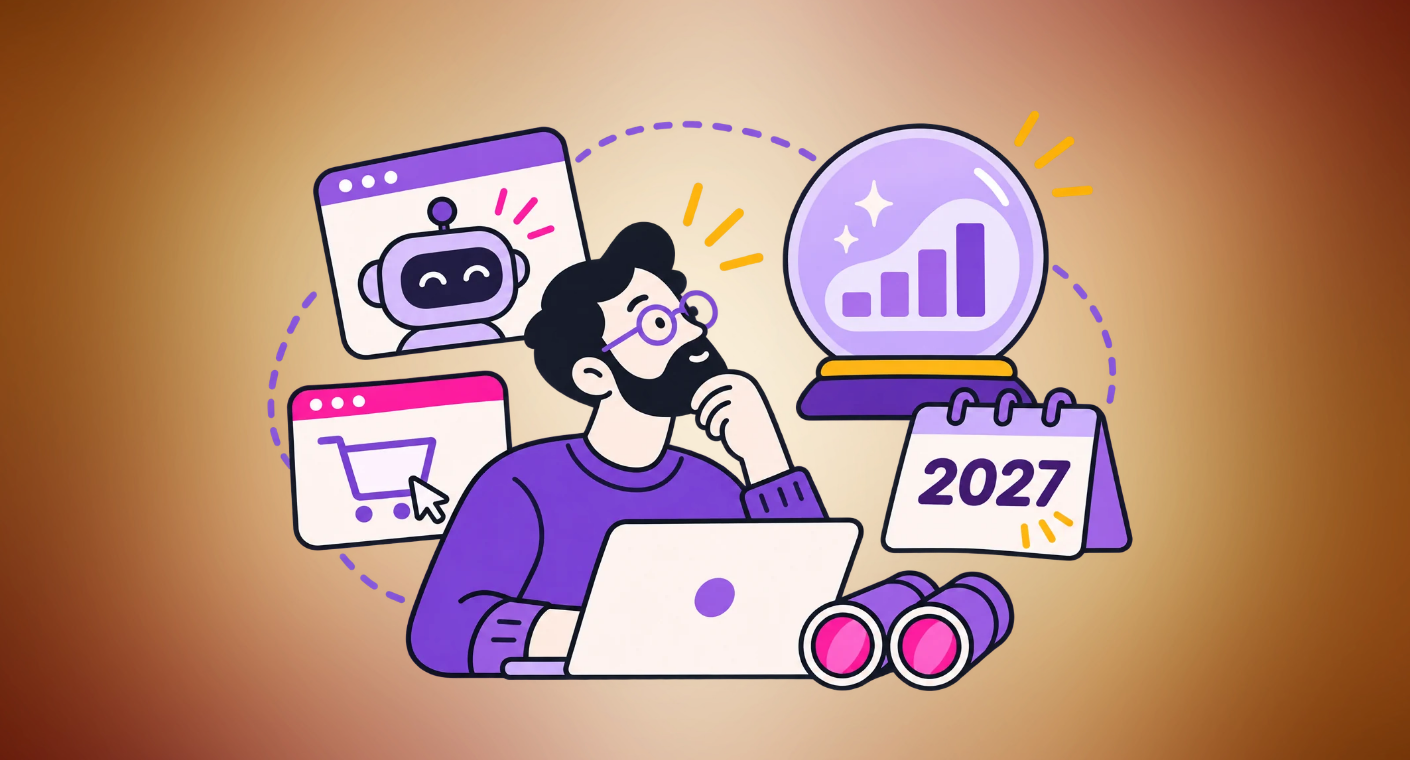

What if your best marketing strategy is no longer enough?
Your customers could be making purchasing decisions before you even get a chance to influence them. AI is helping them compare products, weigh their options, and narrow their choices without ever visiting your website. And on the marketing side, it's beginning to make decisions about which messages get sent, to whom, and when.
With so much changing around how brands reach and engage customers, we asked Movable Ink's Strategy and Client Experience teams to share their predictions for 2027, then invited our partners to weigh in with their own perspectives.
Here's what they're keeping an eye on.
1. Customers Might Make Up Their Minds Before They Meet You
Rachael Porter, Associate Director, Client Experience | Movable Ink
AI is already doing some of the shopping around for your customers, leaving marketers with less influence over their decisions by the time they reach a brand's website.
Take travel. Someone planning a vacation can ask an AI assistant to compare destinations, sift through reviews, find hotels within their budget, and recommend an itinerary. By the time they visit a travel brand's website, they might already have their entire trip planned.
Now imagine that same behavior across retail, financial services, and other industries.
As AI takes on more of the research process, brands could find themselves entering the conversation much later than they're used to, with fewer opportunities to influence the final decision.
The first interaction a brand has with a customer could also be its last chance to win them over.
A generic welcome message isn't going to do much for someone who's already completed hours of research. Marketers will need to recognize what customers are trying to accomplish and respond with information that helps them make a final decision.
That puts even greater importance on the channels brands own. Email, mobile, and web experiences will need to pick up where AI-assisted research leaves off, giving customers a reason to choose one brand over another.
Here's how our partners see this changing the customer journey:

As shoppers rely on AI to discover brands, compare products, and narrow their choices, they may arrive on a brand’s site already knowing what products they’re considering and what questions they need answered.
In 2027, marketers will need to understand what stands between consideration and purchase. Browsing and messaging signals can distinguish a shopper comparing products from one weighing value. Those signals should shape what brands send across SMS, email, and RCS.
An email might explain a product’s benefits in depth, while an SMS answers a specific question. The brands that win will answer the questions AI research leaves unresolved.

Ryan Willette
VP, Global Customer Success & Partnerships


In retail we’re already seeing shoppers start with an AI assistant that compares products and narrows the choice before they ever visit a brand’s site or app.
In 2027, marketers should plan for two jobs: being chosen by the assistant, then earning the customer once they arrive. Those customers show up with intent already formed, so generic journeys will not be enough.
Owned channels, from email to app to store, need to pick up that conversation: more conversational, responsive to real-time signals, and shaped by what the customer is actually trying to do.
Marta Frattini
Director Global Industry Strategy- Retail


2. You’ll Get Better at Anticipating Customer Needs
Tracy Meyer, Associate Director, Strategy | Movable Ink
Most marketing today is built around waiting.
Waiting for someone to abandon a cart, click an email, make a purchase, or stop engaging. Once that action happens, a campaign kicks in.
But by the time a customer takes that step, their needs may have been changing for weeks.
A customer who suddenly starts spending less could be adjusting to a tighter budget. Someone who pays off a loan may be thinking about their next financial goal. A longtime shopper who begins browsing a completely different category might be entering a new stage of life.
These changes can tell brands something important before customers ever fill out a form or make a purchase.
In 2027, AI will help marketers connect those signals and recognize emerging needs earlier.
That opens the door to a different kind of customer experience. Instead of sending a win-back offer after someone stops purchasing, a brand could recognize the early signs of disengagement and adjust its approach. A financial services company could offer relevant guidance as a customer's circumstances change, rather than waiting for them to start researching another product.
Of course, anticipating someone's needs requires more than collecting data. Brands will need to understand what those changes mean and when acting on them would genuinely be helpful.
Brands have spent years collecting customer data, but most of it still ends up in dashboards rather than decisions.
The signals that matter most aren't just what customers click or buy, but changes in their behavior — how frequently they engage, shifts in spending patterns, or when established habits start to change. AI can now connect those signals to anticipate what a customer might need next.
The winners in 2027 won't be the brands with the most data. They'll be the ones that recognize which signals matter and act on them before the customer has to ask.
Barry Latimer
SVP, Head of Enterprise Data & Decisioning


AI can’t anticipate a customer it barely understands. Making AI work for marketing requires context: each customer’s current situation, your business’s offers and goals, and what you’ve already tried.
A frequent flyer whose flight is delayed needs lounge access, not a generic coupon discount. In 2027, the most effective marketers will be those who give agents trusted customer and business context.
That’s why we believe agents need to live in the same platform as enterprise data, where that context lives and stays current. The most valuable next action is solving a problem before the customer has to ask.
Tasso Argyros
VP and GM of CustomerLake


3. The Customer Journey as We Know It Could Be on Its Way Out
Alex May, Director, Strategy | Movable Ink
You can build the most carefully planned customer journey in the world. Every audience, message, trigger, and follow-up accounted for.
And then customers go and do something completely unexpected.
They browse without buying, switch between channels, ignore the perfectly timed offer, or purchase something that wasn't even part of the plan.
With AI taking on more of the decision-making, marketing teams can begin shifting their attention from building individual journeys to defining what those journeys should accomplish.
Say a retailer wants to increase repeat purchases. Rather than creating dozens of campaigns for different customer groups, the team sets that goal and establishes guidelines for how AI should pursue it.
From there, AI can determine who to engage, what content to deliver, and when and where to reach them, adjusting its approach based on customer behavior and what it learns over time.
This is the idea behind Programmatic CRM, where marketing decisions continuously adapt to each customer instead of following a predefined sequence.
Marketers could spend less time designing the path and more time deciding where it should lead.
Of course, handing over more decisions doesn't mean stepping away from the strategy. Marketers will still need to establish priorities, define success, and determine when human judgment should intervene.
Because getting someone to click is one thing. Knowing whether that click is good for the customer relationship is another.
Marketing gets more interesting and strategic when AI can handle the mechanics. You still decide which customer segments to prioritize, what makes your brand unique, and when chasing a conversion could damage the relationship.
At Databricks, we call this approach Infinity Campaigns: marketers set goals and guardrails, while agents continuously adapt each customer’s experience and learn from signals in real time.
In 2027, the best marketers will be more deliberate about the goals they set, and more demanding about the outcomes AI delivers. More clicks mean very little if you’re teaching every customer to wait for a discount.
Tasso Argyros
VP and GM of CustomerLake